
The retirement annuity I was sold at 21, explained over the braai
Not financial advice. This is education, told the way I’d explain it to my own kid over the coals while the wors catches. Your numbers will differ. Before you act on any of it, talk to a fee-transparent professional.
Come. Sit. Grab a cold one, you’re old enough for this one. I’m going to show you how a stranger once sold me a thing called a retirement annuity when I was your age — dressed it up so it looked like a favour, took a cut of my money for the next sixteen years, and left me only slightly worse off than if I’d kissed the money goodbye at the door.
I’m not telling you this story so you feel sorry for my 38-year-old wallet. I’m telling it so that when someone hands you a glossy product with a man in a good suit on the front, you can do the one thing they’re betting you won’t: read the fee. By the end of this you’ll know exactly what three acronyms mean, why a 2% difference ends up worth a million rand, and — the important bit — you’ll be able to run the maths on anything in about ten minutes.
Let’s braai the jargon out of the way first, so none of it slides past you.
Lesson 1: the words, like I’d say them to a kid at the fire
A retirement annuity (RA) is a special box the government gives you tax breaks for filling up, so that Future You doesn’t have to eat peanut butter out the jar at seventy. The deal: you put money in, you get a tax deduction today, and the little bit of happiness is locked away until you’re 55+. The good part is it grows without tax. The bad part is you can’t touch it — and the part nobody warns you about is that every year, a share of what’s inside walks away to pay for the box itself.
The fund is the recipe inside the box — a mix of “safe” and “risky” stuff. In braai terms: green wood burns slow and steady, hardwood burns hot and fast. When you’re young, you’ve got decades of fire left, so the adult money move is hardwood — lots of shares. When you’re near retirement, you switch to green wood — safe bonds and cash — because you can’t afford a flame-out.
The EJK spends all caps in insurance-speak but is blessedly simple in life-speak. It’s pronounced “eff-jay-kah” (the Afrikaans for Effective Annual Cost), and it’s the answer to the only question that matters: what percentage of my money disappears every single year, no matter how the markets do? Think of it as the price tag on the box, printed honestly, as one yearly number. Mine? About 2.7%.
Nobody in a suit reads the EJK to you out loud, by the way. They show you a “growth rate” instead, which is the net rate — after their cut is already taken. Which brings us to the one formula you actually need.
Lesson 2: the one formula (learn this, not the brochure)
Here is the entire financial universe, compressed into one line:
FV = P × (1 + r − f)ⁿ
Where:
- P = what you’ve got now (in Rands)
- r = the gross return — by which I mean what the market itself gives, before anyone takes their cut
- f = the fee — measured by the EJK
- n = how many years
- FV = what you end up with
That little − f sitting inside the brackets is the trap, and this is the part I want you to really feel: the fee is not a tip taken off at the end. It is subtracted from your growth, every year, for decades. It compounds against you just as hard as the market compounds for you. It never sleeps, never burns out, never gives you a public holiday. It’s the critical difference between the wors cooking nicely and the whole grid being a smoldering regret.
Let’s cook a concrete example. Take R100,000. Leave it 30 years. Assume the market gives 10% a year — that’s the gross, the fire’s heat before anyone takes their share. Now run it with two different fees:
| Year | With a 0.5% fee | With a 3.0% fee | The fee cost you |
|---|---|---|---|
| 0 | R100,000 | R100,000 | R0 |
| 5 | R157,424 | R140,255 | R17,169 |
| 10 | R247,823 | R196,715 | R51,108 |
| 15 | R390,132 | R275,903 | R114,229 |
| 20 | R614,161 | R386,968 | R227,193 |
| 25 | R966,836 | R542,743 | R424,093 |
| 30 | R1,522,031 | R761,226 | R760,806 |
Read the very last row again, slowly. Same R100,000. Same 10% market. Same 30 years. With a cheap fee you have R1.5 million; with a pricey fee you have R761,000. The R760,000 you lost was never lost to the market — I turned the market off at a clean 10% in that table — it was the fee, and only the fee. A “small” 2.5% difference isn’t small; it’s the difference between retiring comfortably and retiring wondering if you can still buy firelighters.
That right there is why I say: the fee is the biggest cost you control. You can’t control the market. You can choose whether someone takes 0.5% or 3% of your money every year for forty years.
Lesson 3: my actual situation (so you can copy the method)
Let’s stop with the theory and show you the receipts. These are from my real contract and statements — a Sanlam Cumulus Echo retirement plan, which I was sold at 21 and that got converted to its current form in September 2017:
- Born: 10 August 1988, so I was 21 when this started (1 January 2010) and 38 now
- One-off amount at conversion (2017): R49,981.21
- Monthly premium: started at R752.38, and it grows a contractually-fixed 10% every year — it’s about R1,774 a month now
- Current fund value (Oct 2026): R223,497.80 — that’s the pot before the “Wealth Bonus” that’s payable today (more on that sneaky friend in a moment)
- Returns quoted since 2010: 6.59% a year average; 10.77% a year over the last three
- Inflation over the same period: 4.98% a year — so the “real” growth after inflation is a bit over 1.5%, which is thinner than it sounds
Here’s where it gets uncomfortable. I added up every cent I’ve paid in since the 2017 conversion, grew the premiums at the 10% the contract promised, and compared it to what my pot is actually worth. The number I found made me sit down:
I have paid in about R224,340 since 2017. My fund is worth R223,498 before the bonus. My money has earned effectively nothing. All that 10%-growth talk, the proud “6.59% average” on my statement — after the fees, my actual net return since the conversion works out to about 4.45% a year, and the market did almost all of that. If I’d had the same contributions in a fee-free balanced fund at a 9% gross, my statement should have shown about R287,000.
| Value | |
|---|---|
| What my money should’ve reached (9% gross, no fees) | ≈ R287,172 |
| What my pot actually reached | R223,498 |
| Estimated fees since 2017 | ≈ R62,000 |
Roughly R62,000 has walked away — not in one dramatic hit, but in the almost-invisible drip of ~2.7–3.1% a year on a growing balance. It’s the tap you leave dripping in the garage for a decade and then wonder where the water went. It went down the drain, one monthly statement at a time, in fees that were listed on a page nobody ever made me read.
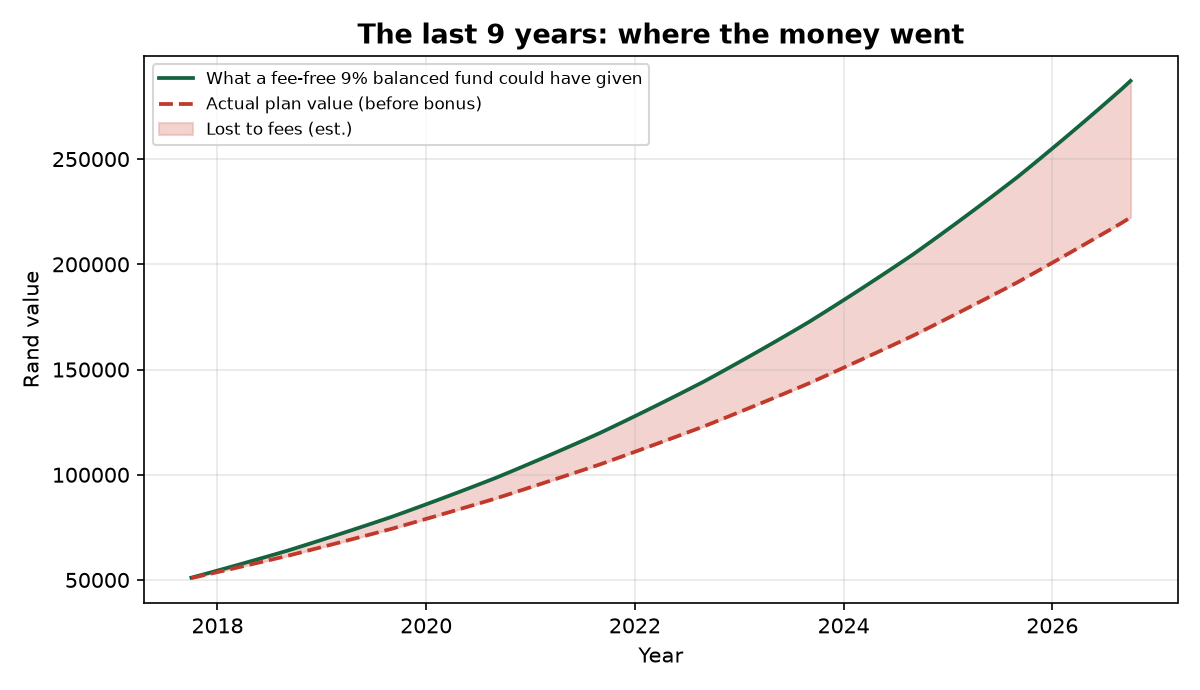
That R62k is an honest estimate with stated assumptions (my gross-return assumption, and my reconstruction of the premium schedule from the contract). The method is the point — this is how you audit any policy in the afternoon, not in a boardroom.
Lesson 4: where exactly the gotcha was (three quiet places)
Now, I want to be fair. The product isn’t evil; it’s just engineered to look like one thing while being another. I found three gotchas, in order of subtlety.
Gotcha 1 — the fee hides inside the growth, not the premium. When I signed, I chose a monthly premium and a fund name. The fee wasn’t a line item I paid at the counter — it’s carved out of the returns, invisibly, monthly, behind the scenes. So my statement proudly displays “6.59% average return” and that’s the net figure — after their cut is already gone. Showing you net-of-fee performance while hiding the fee is like handing a guest a braaied wors and then presenting them with the butchery bill, and calling the meat “free.” The EJK is the fix for this — it makes the hidden fee visible. My benefit statement, in the box ASISA legally forces the insurer to print, says:
| Horizon | EJK (Effective Annual Cost) |
|---|---|
| End after 1 year | 3.1% |
| End after 3 years | 2.7% |
| End after 5 years | 2.7% |
| To retirement (2053) | 1.7% |
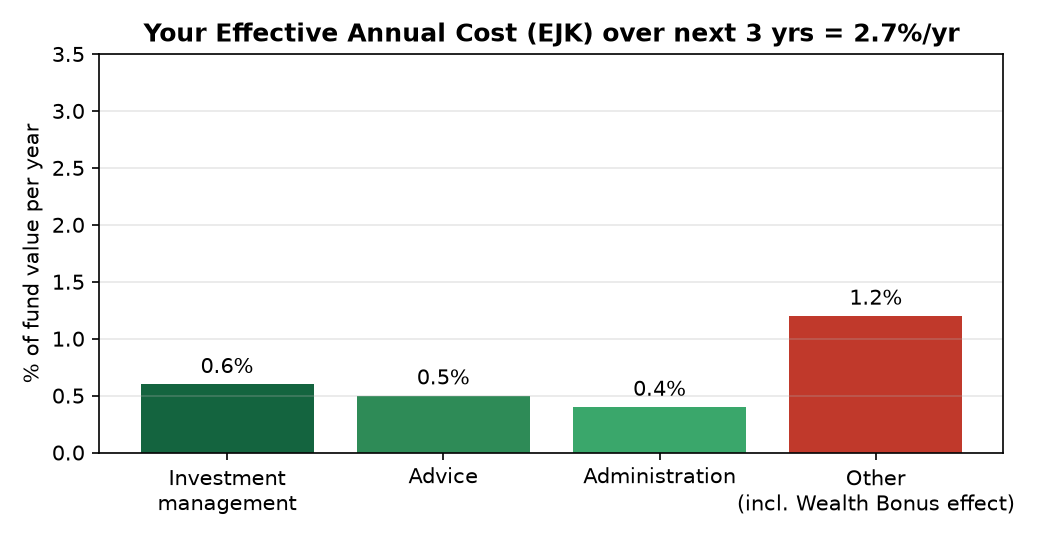
That ~2.7% is the sum of the investment-management fee (0.6%), pure advice (0.5%), administration (0.4%), and then a chunk I lovingly call “other” (1.2%) that includes how the Wealth Bonus is counted in. Two points to file away: one, it’s highest early (3.1%) and only drops to 1.7% by retirement, which sounds nice until you realise that means it’s more expensive precisely when you have the least money, and cheaper when you have the most. Two — and this is the bit that makes me thump the table — the whole number is still ~0.5–1% higher than a good low-fee modern provider would charge.
Gotcha 2 — the “Wealth Bonus” is a handcuff wearing a party hat. My statement gushes that a Wealth Bonus of R223,935 lands at retirement — nearly doubling my pot! Sounds like a gift-wrapped retirement, right? Read the fine print: “only vested Wealth Bonuses are paid if the plan is terminated.” Leave before a vesting point and the unvested bonus evaporates. That’s not generosity; that’s a golden handcuff engineered so the financially-prudent-sounding decision — “stay, for the bonus!” — is exactly the decision that keeps the money parked where they want it. And here’s the truly sneaky bit: Sanlam’s own EJK note says the bonus is counted inside the EJK as an offset, so you’re partly paying more on the front end in exchange for a “bonus” on the back end. They charge you for the privilege of being rewarded. In braai terms: they sell you the firelighters, then ask you to pay for the smoke they keep blowing in your eyes.
Gotcha 3 — the benchmark was chosen to flatter. I asked the fair question: “did my money at least beat the market?” And against the benchmark Sanlam put next to my fund — the moderately-aggressive one — my balanced fund held its own (it beat “cautious” by 0.24%/yr and lagged “aggressive” by 0.64%/yr across 16 years). Sounds fine! And that’s precisely the trick. Because the honest comparison for a 21-year-old with 44 years of runway is not “did my balanced fund keep up with other balanced funds?” — it’s “why was a 21-year-old even in a balanced fund at all?” My fund held roughly 46% in shares. The rational default for my age was dramatically more aggressive than that. Look at the difference over just sixteen years, with the same money and the same 10% reality of what I held versus the more-aggressive benchmark:
| What I held (2010–2026) | Value now |
|---|---|
| My plan (≈46% equity) | R258,306 |
| ASISA modest-aggressive benchmark (≈75% equity) | R270,252 |
A R12,000 gap in sixteen years, from simply being more aggressive — before we even get to the fee. Now compound that gap for the remaining 27 years to 65, on top of the fee gap, and you see why the real damage here isn’t the fee alone. It’s the fee plus the baby-sit-me-all-the-way-to-65 risk allocation.
Lesson 5: why my adviser kept me “safe” (the uncomfortable truth)
This is the question that keeps me up — not out of anger, but because the answer is structural:
- A safe client is a better client for the house. A conservative fund sits still, doesn’t churn, doesn’t panic in a crash, doesn’t phone the adviser to scream “you lost my money!” An aggressive fund that drops 30% in a bad year generates complaints and blame — and a blame-risk is the last thing a commission-earner wants. So “balanced” is the path of least friction, and it’s the default that gets sold.
- Their income is streamed from your parked money. Advice fees trail the assets — they’re paid as a % of the pot, for as long as you stay. A transfer, or an aggressive switch I might exit early, doesn’t serve a fee that depends on keeping assets in place. The product’s entire economics quietly reward one thing: you staying put.
- Regulation 28 caps how aggressive an RA can even be — and here’s where the “safe” default does real damage. Let me explain this properly, because it’s the section most people skim and it matters. Reg 28 is a law that tells retirement funds the maximum they may hold in certain risky assets, to stop a fund loading up 100% on the punt of the day and blowing up. For shares (domestic + offshore combing toward a cap), the limit is roughly 75%. So the most aggressive retirement annuity the law allows is about 75% equity — not 100%. Now here’s the kicker that makes me want to put the tongs down: my fund sat at ~46% equity. The legal ceiling was 75%. I was leaving nearly thirty percentage points of lawful aggression on the table — nobody behind that deserves the explanation “the law wouldn’t let me.” The law would have let him. He just sold me the safest thing on the shelf, the one that maximises his trailing fee and minimises his trouble. The default won; my retirement lost.
- And my own honest share: I didn’t ask. At 21 I signed what a “professional” put in front of me because I assumed he knew better than me. The system worked exactly as designed. The design just wasn’t for me. Owning my half — “I should have read it, and here’s the fee now” — is the first step toward never repeating it.
Lesson 6: what the next 27 years actually look like (the chart that changed my mind)
This is the one that actually moved my behaviour, so pay attention. I modelled the road to age 65 — I retire on 10 August 2053 — under two paths, both starting from my current R223,497.80, with my R1,774/month premium growing an assumed 8% a year:
- Stay in this plan, at its long-run EJK of ~1.7% → net of roughly 7.3% a year
- Same money in a low-fee, high-equity RA at ~0.7% all-in → net of roughly 9.3% a year
Same money in, same years out, the only difference being the fee. Here’s the projected pot at each five-year mark:
| Year | Stay (~7.3% net) | Low-fee high-equity (~9.3%) | The fee gap |
|---|---|---|---|
| 0 (now) | R223,498 | R223,498 | R0 |
| 5 | R470,831 | R508,703 | R37,872 |
| 10 | R894,401 | R1,028,721 | R134,321 |
| 15 | R1,602,324 | R1,950,286 | R347,962 |
| 20 | R2,764,191 | R3,550,034 | R785,843 |
| 25 | R4,644,444 | R6,283,807 | R1,639,363 |
| 27 (age 65) | R5,139,478 | R7,025,517 | R1,886,039 |
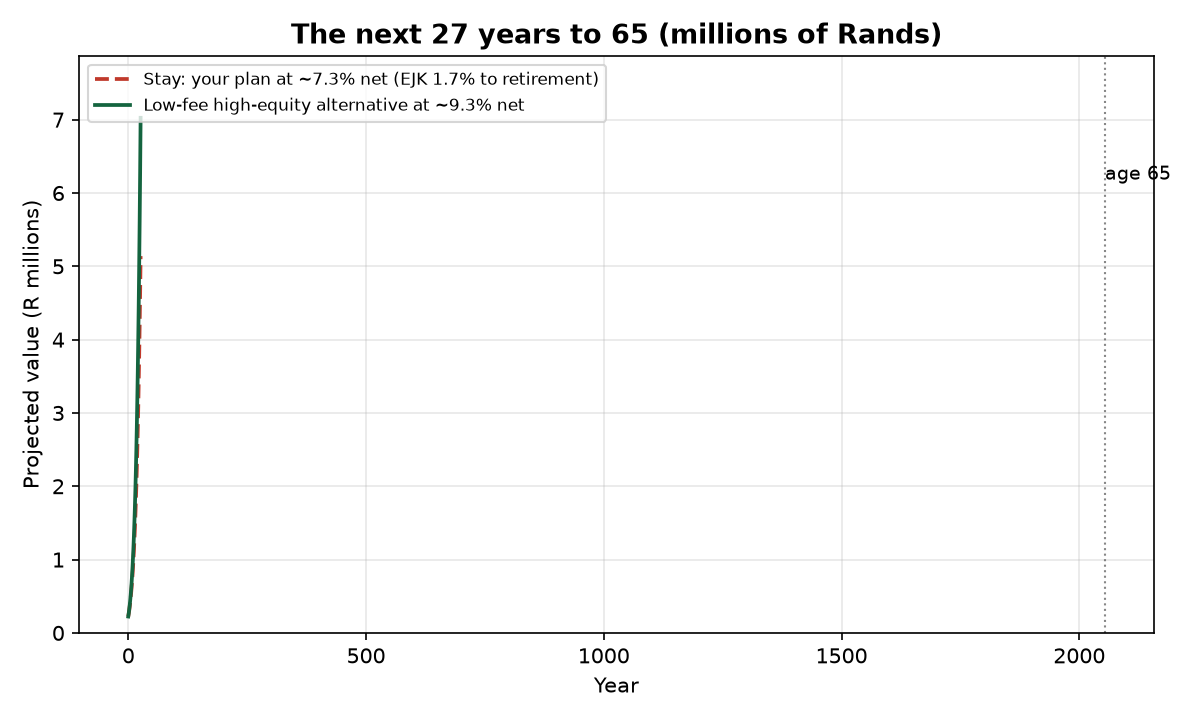
Read the bottom row again. By 65, the fee — and only the fee, with the market held equal — costs me R1.89 million. That’s roughly a quarter (27%) of my entire projected pot, handed over in Rands so that one specific insurer could be my middleman. Not the market. Not inflation. Not a bad year on the JSE. The fee.
Here’s the formula for the monthly version, so you can do yours the same way. A monthly premium that starts at PMT and grows g% a year, over n years, at a net monthly rate r:
FV = PMT × ( ( (1+r)ⁿ − 1 ) / r ) — adjusted month by month, with the premium bumped up each year.
And the rand gap is simply:
Fee gap = FV(low-fee) − FV(stay)
Same P, same PMT, same n, same 27 years. The whole R1.89m gap is the fee in the exponent doing its invisible work. That is not a rounding error. That is a retirement decision made for you by someone else’s pricing sheet — and you were never once read the price out loud.
Lesson 7: what I’m actually doing about it (your options, itemised)
I’m not telling you to run out and cash in your RA. Cashing out early is usually the single dumbest move available — you eat taxes, you can lose the future Wealth Bonus, and you torch the 27-year compounding runway that is the only reason youth still helps you. Panic is the fee’s favourite flavour. Here’s the cool-headed decision tree instead, in the right order:
Step 1 — Get the EJK and current fund value in writing. You are legally entitled to this every year. If you don’t yet know your EJK, you haven’t started — I didn’t for fifteen years.
Step 2 — Ask the decisive question, in writing, to the provider:
“Can this RA be invested in a genuinely high-equity fund (up near the Regulation 28 75% cap)? And at what total Effective Annual Cost? Please itemise the fund, advice, platform and admin charges separately.”
- If the answer is “~1% EJK and yes, high equity” → staying and simply switching the fund inside the RA fixes most of the problem, with zero tax cost and without touching a cent. That’s Option A, and it’s almost always worth checking before anything more drastic.
- If the answer is “2.5%+ EJK and we only do balanced” → the low-fee high-equity RA elsewhere (or a provider-of-choice transfer, which the law allows) becomes Option B, worth modelling properly with your own numbers.
Step 3 — Model both honestly, using Lesson 2’s formula. Put in your fund value, your premium, your years-to-go, and the quoted EJKs. Don’t let anyone hand you a single smooth “growth rate” — that’s the flattery. Demand the fee; the fee decides the outcome.
Step 4 — fix the bigger problem. An RA you can’t touch cannot be your emergency fund, and relying on it as your only savings is not a strategy, it’s a single point of failure. The classic ladder — emergency fund → kill high-interest debt → then invest — matters even if this RA never moves. More money going into a low-fee, high-equity account compounds far faster than any amount of clever fee-fighting on this one policy ever will.
What I want you to remember (the whole braai in one wors)
- A “great” return on a statement is net of fees. That’s the number they want you to see — it hides the biggest cost you control.
- The EJK is the price tag. It’s on every benefit statement. Find it, write it on your hand, and run the fee formula with it once. Ten minutes of arithmetic can outperform a decade of “expert” advice.
- Fees compound against you. A 2% difference sounds like a rounding error and is actually a retirement — R1.89m of mine by age 65.
- Regulation 28 means your RA can legally hold up to around 75% shares. If yours is parked at 46% “balanced,” you’re not being prudent — you’re being short-changed by a default that makes someone else’s fee fatter and no one yours.
- And the single most powerful question in personal finance is still the one nobody asks the person selling: “What are you being paid, in Rands, for this — and who actually pays it?” If the answer is “a percentage of your money, for as long as you stay,” make them say it slowly, and then get the EJK in writing before you sign anything.
Now go. Fires don’t feed themselves. And the next time a man in a good suit slides a brochure across a table, hold the tongs steady, look him in the eye, and ask where the fee lives before you compliment the print job.
Standing disclaimer: this is educational, not financial advice. Figures are as of October 2026 and subject to change. I rebuilt my own contribution schedule with stated assumptions — a gross-return assumption and an 8% forward premium-growth assumption — so your actual numbers will differ. The EJK and Wealth Bonus figures are quoted from Sanlam’s own statements. Run the maths yourself and, before changing anything, talk to a qualified professional whose fee is transparent. Compound, braai, repeat.